Custom Packaging Options
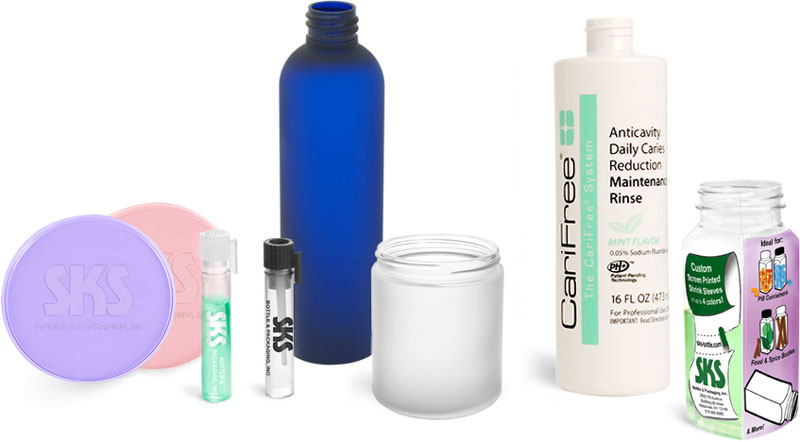
SKS offers a wide selection of added services to assist in the creation of unique, customized packaging options for your company. Choose from decoration, customization, sustainable packaging and more for a personalized experience when creating, expanding, or revamping your product line. Request a quote today for any of these services to get started.
Decorating Glass, Plastic, and Metal Containers
SKS provides a variety of options for detailed customization and decoration of both closures and containers. Decorating your containers can help to elevate your brand with a finished, professional look.
Printing on metal tins can strongly impact your brand and is available for the range of metal containers SKS has in stock.
SKS is also able to apply custom labels onto packaging you have purchased prior to shipment. The minimum quantity for this labeling service is 5,000 pieces.
For more information regarding these added services, or to begin the fast and easy quoting process, email our Customer Care team.
 Get a Quote
- Additional Services Include:
- Silk Screening
- Printed Shrink Sleeves
Printing on metal tins can strongly impact your brand and is available for the range of metal containers SKS has in stock.
SKS is also able to apply custom labels onto packaging you have purchased prior to shipment. The minimum quantity for this labeling service is 5,000 pieces.
For more information regarding these added services, or to begin the fast and easy quoting process, email our Customer Care team.
Get a QuoteCustomized Packaging Design
SKS can customize existing packaging or create a brand new container mold. When looking to distinguish your brand, choose from the dynamic services SKS has to offer.
These services have varying minimums and lead times, which will be indicated during the quoting process. Ready for a quote? Our Customer Care department can help you create one-of-a-kind packaging!
Get a Quote
- Customized Packaging Options:
- Custom Molds
- Customized Disc Liners
- Frosting Services
- Custom Coloring
These services have varying minimums and lead times, which will be indicated during the quoting process. Ready for a quote? Our Customer Care department can help you create one-of-a-kind packaging!
Get a QuoteSustainable Packaging
SKS offers environmentally conscious sustainable packaging options, which have a reduced production carbon imprint, are entirely recyclable, and reduce waste. Design containers composed of PCR or PIR plastic in the size, style, and color of your choosing.
View the variety of sustainable packaging SKS has in stock to create eco-friendly product lines. Choose from hemp zipper bags for toiletry sets, paperboard packaging for cosmetics, and PIR and PCR jars for body care products and more.
Get a Quote
- Sustainable Packaging Options:
- PIR Packaging
- PCR Packaging
View the variety of sustainable packaging SKS has in stock to create eco-friendly product lines. Choose from hemp zipper bags for toiletry sets, paperboard packaging for cosmetics, and PIR and PCR jars for body care products and more.
Get a QuoteTurnkey Production
SKS offers turnkey production for our .15 oz white polypropylene lip balm tubes, meaning that the lip balm tubes are filled and decorated before being shipped.
Step One: Choose a single color logo/image to be adhered to the lip balm tubes.
Step Two: Select a flavor of lip balm to be filled. Available flavors include spearmint, cherry, and vanilla. Each flavor includes SPF 23, aloe, and UVA/UVB protection for top-of-the-line lip care.
The minimum order for this service is 25,000 lip balm tubes, with a lead time of roughly 8-10 weeks after color and artwork approval. Email our Customer Care department to begin the quoting process.
SKS also carries a wide range of empty lip balm tubes for self-filling. SKS can offer a variety of customizability through silkscreening, labeling, and custom colors for in stock lip balm tubes to create a dynamic product line.
Get a Quote
Step One: Choose a single color logo/image to be adhered to the lip balm tubes.
Step Two: Select a flavor of lip balm to be filled. Available flavors include spearmint, cherry, and vanilla. Each flavor includes SPF 23, aloe, and UVA/UVB protection for top-of-the-line lip care.
The minimum order for this service is 25,000 lip balm tubes, with a lead time of roughly 8-10 weeks after color and artwork approval. Email our Customer Care department to begin the quoting process.
SKS also carries a wide range of empty lip balm tubes for self-filling. SKS can offer a variety of customizability through silkscreening, labeling, and custom colors for in stock lip balm tubes to create a dynamic product line.
Get a QuoteQuotes
Specialized decorating requests and special pricing are available for large volume orders (typically 10,000 pcs or more) when you create a custom quote. To begin this process, simply email Customer Care with the stock numbers of interest, the quantity you would like to order, and any decorating ideas or requests.
Many custom orders require 50% payment when the order is placed and the balance before shipment. We accept major credit cards: Visa, Master Card, or AMEX.
Each custom quote lists the cost of the items being purchased, created, and/or decorated, as well as any additional handling fees. Shipping is determined when placing the order.
Get a Quote
Many custom orders require 50% payment when the order is placed and the balance before shipment. We accept major credit cards: Visa, Master Card, or AMEX.
Each custom quote lists the cost of the items being purchased, created, and/or decorated, as well as any additional handling fees. Shipping is determined when placing the order.
Get a QuoteContact Us
If you need assistance with past, current, or future orders, contact our Customer Care department today!
Email
Call 1-518-880-6980, 8 am - 5 pm EST
Fax 1-800-880-6990
Live Chat by selecting the chat button in the bottom right corner
You can also email our Customer Care department to begin the quoting process using this form.
Call 1-518-880-6980, 8 am - 5 pm EST
Fax 1-800-880-6990
Live Chat by selecting the chat button in the bottom right corner
You can also email our Customer Care department to begin the quoting process using this form.
Chat with Us